
Sections without speed limits
Some Autobahn sections have no fixed speed limit, but the recommended speed is 130 km/h (81 mph). Always adjust your speed to traffic, weather, and road conditions.
Keep right after overtaking
German lane discipline is strict: use the left lane to overtake and return to the right when it is safe. Remaining in the left lane unnecessarily can obstruct faster traffic.
Choose the right kind of rest stop
Raststätte, Autohof and Parkplatz offer different levels of service. Check the signs ahead so you know whether fuel, food, toilets or only parking will be available.
Create an emergency corridor early
As soon as traffic slows to a crawl or stops, form a Rettungsgasse between the far-left lane and the lane immediately to its right so emergency vehicles can pass.
Autobahn in Germany
The German Autobahn are famous because they are some of the few public roads in the world without blanket speed limits for cars and motorcycles. Lack of blanket speed limits does not appear to negatively impact the road safety of Autobahn compared with motorways in other countries; motorways are safer than other road types. Perhaps this is in part because traffic can be heavy enough to restrict speeds to little above the typical motorway speeds found elsewhere, or due to reducing the exhaustion of the drivers by shortening their travelling times.
Just like all European motorways, the Autobahn have multiple lanes of traffic in each direction, separated by a barrier with grade-separated junctions and access restricted to certain types of vehicles only.
For German and Austrian autobahns only accept motor vehicles that can obtain a speed of at least 60 km/h (37 mph). For Swiss autobahns the vehicles must be able to obtain a speed of at least 80 km/h (50 mph). In most countries, "Autobahn" usually refers to the German autobahn specifically.
The German Autobahn network is approximately 13,259 kilometers (8,239 miles) long. This makes it one of the largest motorway networks in Europe, although it is considerably shorter than the expressway network in China and the Interstate Highway System in the United States. Germany nevertheless has a very dense Autobahn network relative to the size of the country.
Some of the world's largest motorway-standard road networks
China: 199,400 km (123,900 mi) of expressways
United States: 78,600 km (48,830 mi) of Interstate Highways
Spain: 15,886 km (9,871 mi) of autopistas and autovías
Germany: 13,259 km (8,239 mi) of autobahnen
Japan: 12,403 km (7,707 mi) of high-standard arterial highways
France: 11,752 km (7,302 mi) of autoroutes
The figures above compare high-standard roads that are broadly comparable with the German Autobahn: divided roads intended for high-speed through traffic, with controlled access and predominantly grade-separated junctions. Ordinary highways, rural highways and other major roads that do not meet this standard are not included. Road classifications differ between countries, however, so international figures should be regarded as approximate comparisons rather than an exact global ranking.
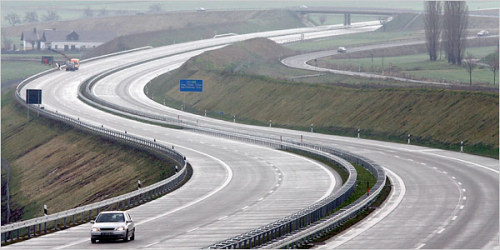
This section of Autobahn near the Czech border probably have speed limits
Check out this Travel Guide to Germany written by Mark Spencer at Carre VIP.
Keep a safe following distance
Tailgating is taken seriously in Germany. Maintain enough distance to react safely, especially when speeds are high and traffic conditions can change quickly.
Watch variable message signs
Overhead electronic signs can introduce temporary speed limits, lane closures or warnings. Their instructions apply even on a section that is normally unrestricted.
Overtake trucks decisively
Heavy vehicles have large blind spots and travel at lower speeds. Pass smoothly, leave sufficient room and avoid staying beside a truck longer than necessary.
Prepare for winter conditions
Snow, ice and slush can change Autobahn conditions quickly. Suitable winter tyres are required when wintry road conditions are present in Germany.